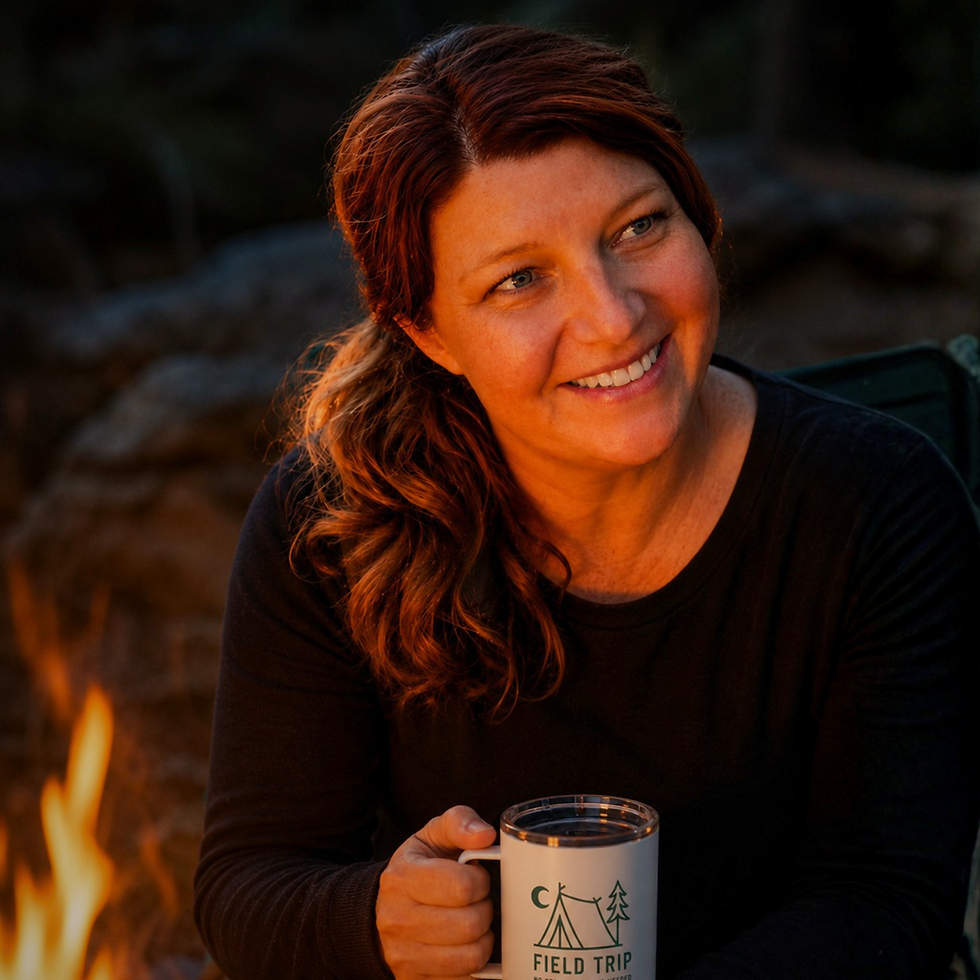
Campfire Chat: Speak for the Trees, Even When the Room Gets Quiet
There’s a kind of silence that feels peaceful.
And then there’s the kind that makes the hair on the back of your neck stand up.
Lately, I’ve been thinking about the second kind.
The quiet around our public lands. The quiet from brands that built their whole vibe on mountain mornings, dusty boots, trail maps, camp coffee, and the promise of wild places—yet somehow go weirdly mute when those same places need defending. It’s a silence that says a lot, actually.
So, pull up a camp chair. Let’s chat.
🎧 On in the Background
The sound of silence.
Not the poetic kind. Not the pine-trees-in-the-wind kind. I mean the strategic, polished, brand-safe kind.
I’ve had our “This Land Is Your Land” piece on my mind, along with what’s happening across the U.S. Forest Service right now. The agency says its current reorganization is meant to move staffing capacity and decision-making authority closer to the field, and that fire operations will continue without interruption. At the same time, some forest units are acknowledging staff reductions and budget constraints in plain English.
That tension matters.
Because shared land is not some abstract idea. It’s where a whole lot of us learned how to breathe again. It’s where families camp on a budget, where kids see their first waterfall, where tired adults remember they’re not machines, where dogs lose their minds in the best possible way. Public lands are the backdrop and backbone of the outdoor life so many companies profit from.
Which is why brand silence feels especially loud right now.
Seriously. You cannot wrap yourself in the aesthetics of public land and then disappear when public land needs people to speak up. You cannot sell the camp mug, the sun hoodie, the rooftop tent, the “find yourself outside” fantasy—and then suddenly become too delicate to say anything when the places behind your product photos are under pressure.
That’s not neutrality. That’s outsourcing courage.
And look, not every company has to turn into a policy shop overnight. But if your brand has made money off the existence of shared wild places, I do think you owe those places more than a mood board.
Which leads me to what’s…
🌿 On My Mind
The Lorax has been living rent-free in my head.
The exact line is: “Unless someone like you cares a whole awful lot, nothing is going to get better. It’s not.”
That one still hits.
Because for all our talk about loving nature, there comes a point where love has to sound like something. It has to cost a little something. It has to move past aesthetic appreciation and into actual stewardship.
That’s part of why I put a note on our homepage about this issue. Small? Yes. Purposeful? Also yes.
Not every statement has to be giant to matter. Some of them just have to be clear. We care. We’re paying attention. We are not going to build a business around the outdoors and then act coy when the outdoors need advocates.
It’s also why Field Trip renewed our commitment to 1% for the Planet. Business members commit at least 1% of annual sales—not profits—to approved environmental partners.
And that feels especially important right now.
Because no, money does not grow on trees. But our money should absolutely back up what we say about loving them.
📖 On My Nightstand
I keep one on my nightstand because it is exactly the kind of tiny, useful thing that makes me irrationally happy. Mine is there for those middle-of-the-night, half-asleep bathroom trips when I do not want to blind myself, wake my husband, or make the catastrophic mistake of grabbing my phone “just for the flashlight.”
Because we all know how that goes.
One inevitable glance at email and suddenly it’s 2:07 a.m. and I’m mentally reorganizing my life.
The Twilight lantern is one of those things that started as camping gear and quietly became house gear.
Which is exactly why I pointed to Solight in “Your Camping Gear Is Basically Emergency Gear in Disguise.” Because honestly? A lot of the stuff that serves us well outside serves us really well at home too—especially when the power goes out, or the weather gets weird.
🔥 Sparks
I am, in fact, a little obsessed with our JetBoil Genesis Basecamp System.
It has become one of those pieces of gear that keeps proving its worth in multiple lanes. Camping? Obviously. Emergency backup? Yep. But lately, as South Carolina starts cranking up the heat and grilling is the answer every night to “what’s for dinner?,” it has also become my favorite sidekick for keeping the stovetop action outside.
And wow, does that make a difference. In practical terms, I can keep the mess, the heat, and the meal all in one place instead of turning my kitchen into a muggy, hot mess.
📍 Pinned to the Map
Liam and I just got back from Asheville, North Carolina, and that place still has a firm grip on my heart.
I wrote about it in “Big House, Better Backyard,” but the short version is this: Asheville is absolutely worth a visit if you get the chance. The whole Blue Ridge Mountain area keeps calling us back.
Maybe it’s the layered ridgelines. Maybe it’s the way the air feels like a reset button. Maybe it’s the fact that you can be eating a good meal one minute and chasing a trailhead the next.
Whatever it is, I’m in.
Not every place you love needs a grand explanation. Some places just fit your spirit right the first time, and then keep doing it.

🧵 Thread I’m Pulling
Cleaning up.
Apparently, spring hits and I become part woman, part nesting bird, part environmentally conscious raccoon.
I want everything brighter. Lighter. Simpler. Less grimy. Less cluttered. Less dumb.
But I’ve been thinking about “clean up” in a bigger way, too—not just tidying, but greening up. Home, campsite, yard, vehicle, all of it.
Before I buy anything now, I’m trying to pause and ask:
Do I actually need this?
Do I already own something that does the job?
And if I really do need to buy it, what’s the greener option?
I am not doing this perfectly, but this pause before purchase is moving the needle.
That’s also why I’m excited that we’re launching our new “Let’s Clean Up!” series. Over the next few months, we’ll be sharing our best tips, greener product swaps, DIY cleaning experiments, and practical ideas for making the spaces we live in a little less wasteful and a lot more thoughtful.
Because cleaning up doesn’t have to mean buying a cart full of new stuff in prettier packaging. Sometimes it means buying less. Sometimes it means using what you’ve got. Sometimes it means realizing the greenest thing in the room is the thing you didn’t replace.
Funny how that works.
🎒 Packing Out
If you do nothing else this week, go visit DarkSky International and do a quick audit of your household lighting using their five principles for responsible outdoor lighting.
Their framework is simple: outdoor lighting should be useful, targeted, low-level, controlled, and warm-colored. DarkSky says following those principles can save energy and money, reduce light pollution, and lessen wildlife disruption.
And since it’s International Dark Sky Week, this is a great time to pay attention. Dark skies matter for way more than starry Instagram moments. They matter for wildlife, ecosystems, and human health. Give “Lost in the Stars” a read for more on this.
Maybe that’s the thread tying all of this together: lighting less, buying smarter, using what we have, putting some money behind our values, and refusing to act like we have no responsibility to speak up.
The trees do not need more admirers. They need more people willing to speak for them.